Vodafone and Three offer home broadband through their mobile networks, removing the need for a fixed phone line or an engineer visit. Both include unlimited data, Wi-Fi 6 equipment and indoor or outdoor 5G hub options.
Three has the advantage for speed potential and gives customers longer to test the connection. Vodafone offers a choice between two speed plans and currently delivers better value once its reward is included.
Your local 5G signal remains the most important factor. Check availability with both providers because indoor coverage, mast capacity and the position of your home can produce different results.
Vodafone and Three 5G broadband compared
| Feature | Vodafone 5G Broadband | Three 5G Home Broadband |
|---|---|---|
| Download speed | Up to 50Mbps or 150Mbps | Average 150Mbps |
| Data allowance | Unlimited | Unlimited |
| Contract options | One, 12 or 24 months | One, 12 or 24 months |
| Wi-Fi equipment | Wi-Fi 6 indoor hub or outdoor hub with Power Hub | Wi-Fi 6 indoor hub or outdoor hub with eero 6 |
| Installation | Self-installation | Self-installation |
| Return period | 14 days | 30-day money-back guarantee |
| Phone line | Not required | Not required |
| Annual price change | Fixed increase each April | £3.50 increase each April |
Current Vodafone and Three 5G deals
| Plan & speed | Details | Price | More info |
|---|---|---|---|
| Vodafone 5G Broadband 150 150Mbps average speed 24-month contract |
|
£14 per month | See deal |
| Vodafone 5G Broadband 50 50Mbps average speed 24-month contract |
|
£14 per month | See deal |
| Three 5G Hub Unlimited Home Broadband 150Mbps average speed 24-month contract |
|
£15 per month | See deal |
What you need to know
- Vodafone and Three offer 5G home broadband with 24-month, 12-month and one-month contracts. Longer contracts cost less, while rolling plans give you greater flexibility.
- Both providers include unlimited data and a router. The indoor hubs are self-installed, so you do not need a fixed phone line or an engineer visit.
- Vodafone and Three also offer outdoor 5G hubs for homes where walls or coated windows weaken the indoor mobile signal.
- Three includes next-working-day delivery on eligible orders and a 30-day money-back guarantee. Its 5G service offers an average 20Mbps upload speed.
- Prices increase each April on longer contracts. Compare the full contract cost rather than relying only on the starting monthly charge.
- Vodafone and Three now share network infrastructure through VodafoneThree, but their home broadband services are not identical.
- Three gives customers a 30-day money-back guarantee, making it easier to test evening speeds and signal quality. Vodafone’s 14-day return period gives less time to assess performance.
- Enter your postcode below to see the complete range of available 5G broadband deals.
Availability Checker
Speed and reliability
Three offers an average 150Mbps download speed. This figure applies to at least half of customers within its 5G coverage area during the evening peak period. Some homes receive faster speeds, while others receive considerably less.
Vodafone separates its service into plans offering up to 50Mbps and up to 150Mbps. The faster plan has enough bandwidth for 4K streaming, video calls, gaming and large downloads across several devices, provided the 5G connection remains consistent.
Three has greater speed potential because its 150Mbps figure is an average rather than a maximum. Vodafone gives customers a clearer speed limit and a cheaper entry-level option for lighter use.
Neither service delivers the consistency of a good full fibre connection. Performance can change according to:
- Distance from the mobile mast
- Walls, insulation and nearby buildings
- Indoor hub position
- The number of people using the local mast
- Whether the hub connects through 5G or falls back to 4G
Placing an indoor hub beside an upstairs window can improve signal quality. An outdoor hub is usually better when thick walls or coated windows weaken indoor reception.
Indoor and outdoor hub options
Both providers choose between indoor and outdoor equipment according to expected signal conditions.
Vodafone supplies its Outdoor 5G Hub with an indoor Power Hub. Three’s outdoor package includes an eero 6 router. Both are self-install products, although fitting outdoor equipment can be more difficult in rented homes or upper-floor flats.
The exact indoor Three router can vary. Current models offer Wi-Fi 6, but the casing, controls and connection ports are not always identical.
Customers can connect a separate mesh Wi-Fi system through Ethernet. Using two routers together can create double NAT, which can cause problems with port forwarding and some online games. Router or access-point settings might need changing.
Contracts, price increases and cancellation
Vodafone and Three offer one-month rolling plans alongside longer contracts. Shorter agreements cost more but reduce the financial risk if coverage changes or you expect to move home.
The cheapest offers usually come with a 24-month contract. Both providers apply annual price increases, so compare the full contract cost rather than the initial monthly charge alone.
Cancelling after the cooling-off or money-back period can result in an early termination charge. Customers must also return loaned 5G equipment when required. Vodafone can charge up to £150 if its hub is not returned, while Three also applies a non-return charge to relevant equipment.
Streaming, gaming and working from home
Either 150Mbps service has enough download capacity for several HD streams, 4K television and everyday home working. The connection must remain on a reliable 5G signal to deliver those speeds consistently.
Gaming performance depends more on latency and jitter than download speed. A good 5G connection can deliver responsive casual and online gaming, but mast congestion or a switch to 4G can create sudden latency increases. Competitive gamers will usually receive more consistent performance from full fibre broadband.
Video meetings need reliable upload speeds. Neither provider publishes a fixed average upload speed for every customer, and upload performance can change significantly between premises. Anyone who regularly sends very large files or runs several video meetings at once should test the connection during busy periods.
The better 5G broadband provider
Three is the better option for customers who want the highest speed potential and a longer home trial. Its average 150Mbps service can exceed Vodafone’s 150Mbps maximum where local network conditions are favourable. The 30-day money-back guarantee also gives you more time to test evening performance.
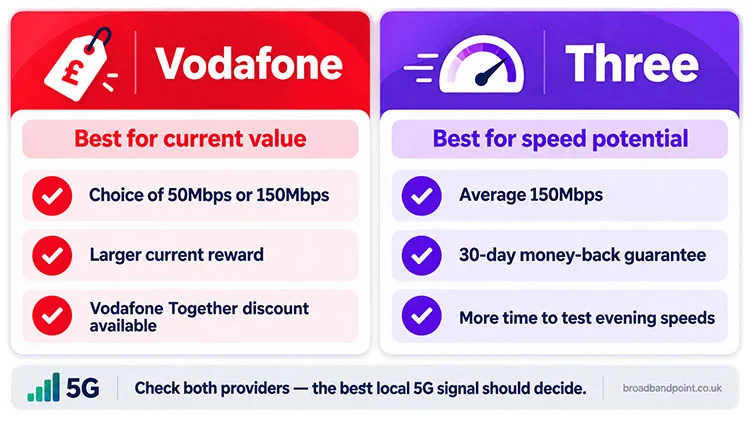
Vodafone is the better option for customers who want a choice of speed plans or the lowest current total cost after the reward. Existing Vodafone mobile customers can also qualify for a Vodafone Together discount on eligible contracts.
Our recommendation is to check both providers and prioritise signal quality over small differences in price. If both are available with similar expected coverage, choose Vodafone for current overall value and Three for speed potential and the longer testing period.
Frequently asked questions
Does the VodafoneThree network merger make both services identical?
No. Vodafone and Three customers can benefit from shared network infrastructure, but the home broadband packages remain separate. The providers use different availability checks, routers, speed descriptions, contract terms and customer accounts.
Network sharing also does not guarantee identical performance at every premises. Hub placement, local capacity and the frequency used by the nearest mast can still produce different results.
Will the 5G hub continue working when 5G is unavailable?
Yes. Vodafone and Three 5G hubs can fall back to 4G when a 5G connection is unavailable. The internet connection should continue, but download speeds can be lower and latency can increase.
Regular fallback to 4G usually indicates that the hub needs a better position or that indoor 5G coverage is insufficient. An outdoor hub could improve the connection in this situation.
Does either provider offer a minimum guaranteed speed?
Neither provider offers the same personalised minimum speed guarantee commonly available with fixed-line broadband. Mobile broadband speeds change with signal conditions and demand on the local mast.
Three quotes an average 150Mbps download speed, while Vodafone offers maximum speeds of 50Mbps or 150Mbps. These figures do not guarantee that an individual home will receive that performance continuously.
The safest option is to test the service throughout the return period, including weekday evenings when the network is busiest.
Can CCTV, port forwarding or a home server be used?
Basic cloud-connected CCTV systems usually operate normally. Direct port forwarding, remote server access and some advanced gaming configurations can be more difficult because mobile broadband connections can use carrier-grade NAT and changing IP addresses.
Do not assume that either service includes a public IPv4 address. Customers who need incoming connections for a server, older CCTV recorder or specialist VPN should confirm the current network configuration before ordering. A fixed broadband service with an available public IP address is usually better for these uses.
Can the hub be taken to a new home?
Three allows customers to take an indoor hub when moving within the UK, but coverage must be checked at the new postcode. Vodafone’s indoor hub can also be relocated, although the service is qualified for the registered home and coverage should be checked before the move.
Outdoor hubs require removal and installation at the new premises. Neither provider’s home broadband service is intended for international roaming.