
Vodafone is the better broadband provider overall. It offers wider full-fibre availability, competitive package costs and symmetrical upload speeds across parts of its network.
EE remains an excellent choice for its Wi-Fi 7 router, lower complaint rate and faster maximum download speed. However, EE’s 8Gbps service has very limited availability, while Vodafone’s multi-gigabit packages reach more premises.
This comparison focuses only on home broadband, routers and related broadband features.
EE and Vodafone Broadband compared
Winner: Vodafone
| Feature | EE Broadband | Vodafone Broadband |
|---|---|---|
| Part-fibre speeds | Average 36Mbps and 67Mbps | Average 35Mbps and 67Mbps |
| Full-fibre range | Average 100Mbps to 1.6Gbps | Average 74Mbps to 2.2Gbps |
| Maximum download speed | Up to 8Gbps | Up to 2.2Gbps i |
| Fixed networks | Openreach | Openreach, CityFibre, Community Fibre |
| Upload speeds | Asymmetric | Symmetrical & asymmetric |
| Router | Smart Hub 7 Plus with Wi-Fi 7 | Power Hub with Wi-Fi 6 |
| Enhanced Wi-Fi option | Smart Hub 7 Pro and Wi-Fi extender | Ultra Hub 7, booster and 4G backup with Pro 3 |
| Standard contract | 24 months | 24 months |
| Annual price rise | £4 from 31 March | £3.50 from 1 April |
| Ofcom complaint rate | 6 complaints per 100,000 customers | 8 complaints per 100,000 customers |
| Social tariff | No social tariff | Fibre 2 Essentials |
| Best for | Router and customer service | Value, availability and upload speeds |
Vodafone takes the overall win, although EE leads in several important areas.
Current EE and Vodafone broadband deals
Winner: Vodafone
Vodafone wins on current overall value through competitive package costs, free setup on the plans below and voucher offers. EE becomes more competitive on its faster full-fibre packages.
| Plan and speed | Deal details | Monthly price | More Info |
|---|---|---|---|
| Vodafone Full Fibre 150 |
|
£22 | See deal |
| EE Full Fibre 150 |
|
£22.99 | See deal |
| EE Full Fibre 500 |
|
£24.99 | See deal |
| Vodafone Full Fibre 500 |
|
£25 | See deal |
| Vodafone Full Fibre 910 |
|
£26 | Check deal |
| EE Full Fibre 900 |
|
£25.99 | See deal |
Availability and package details depend on the broadband network serving your home.
Use our broadband postcode checker
Download speeds
Winner: EE
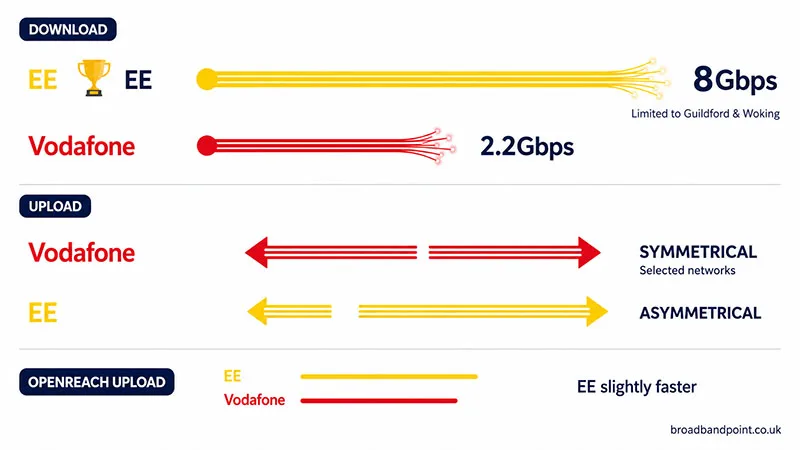
EE offers the fastest maximum download speed. Its Advanced Full Fibre range includes 2.3Gbps and 8Gbps packages, but these are limited to Guildford, Woking and surrounding areas at present.
EE’s widely available full-fibre range reaches 1.6Gbps. Vodafone offers packages up to 2.2Gbps across selected full-fibre areas, giving it broader multi-gigabit availability.
Most households will choose a package between 150Mbps and 910Mbps. At these speeds, both providers offer enough bandwidth for streaming, gaming, video calls and multiple connected devices.
Upload speeds
Winner: Vodafone
Vodafone offers symmetrical speeds through CityFibre, Community Fibre and selected partner networks. A symmetrical connection gives you an upload speed equal to the download speed, which is useful for cloud backups, large file transfers, livestreaming and frequent video calls.
Vodafone’s Openreach packages use lower upload speeds. On Openreach, EE offers fully 30Mbps upload speed with Full Fibre 150, 75Mbps with Full Fibre 500 and 110Mbps with Full Fibre 900. Equivalent Vodafone packages offer 27Mbps, 68Mbps and 105Mbps.
Vodafone therefore wins if a symmetrical service is available at your home. EE has a small advantage when both providers use Openreach.
Full-fibre availability
Winner: Vodafone
Vodafone combines coverage from Openreach, CityFibre, Community Fibre and selected smaller full-fibre networks. This gives it wider full-fibre availability and access to symmetrical packages in more areas.
EE mainly uses the Openreach network. Its standard packages reach a large part of the UK, but its fastest 2.3Gbps and 8Gbps services remain restricted to a small number of locations.
A postcode check remains essential because Vodafone’s speeds, upload speeds and router options vary according to the network serving the premises.
Routers
Winner: EE
| Feature | EE Broadband | Vodafone Broadband |
|---|---|---|
| Standard router | Smart Hub 7 Plus | Power Hub |
| Wi-Fi standard | Wi-Fi 7 | Wi-Fi 6 |
| Wireless bands | Dual-band: 2.4GHz and 5GHz | Dual-band: 2.4GHz and 5GHz |
| Wireless configuration | 4×4 on both bands | 2×2 on 2.4GHz a nd 4×4 on 5GHz |
| Ethernet connections | 1×2.5Gbps LAN, 3×1Gbps LAN and 1×2.5Gbps WAN | 4×1Gbps LAN and 1×1Gbps WAN |
| Enhanced router | Smart Hub 7 Pro with tri-band Wi-Fi 7 | Ultra Hub 7 with dual-band Wi-Fi 7 |
| Wi-Fi extender | WiFi Extender 7 Plus or WiFi Extender 7 Pro, | Super WiFi 7 Booster with Pro 3 |
| Best standard router | EE | — |
EE wins because its standard Smart Hub 7 Plus uses Wi-Fi 7 and includes a 2.5Gbps Ethernet connection. Vodafone’s standard Power Hub uses Wi-Fi 6 and Gigabit Ethernet ports.
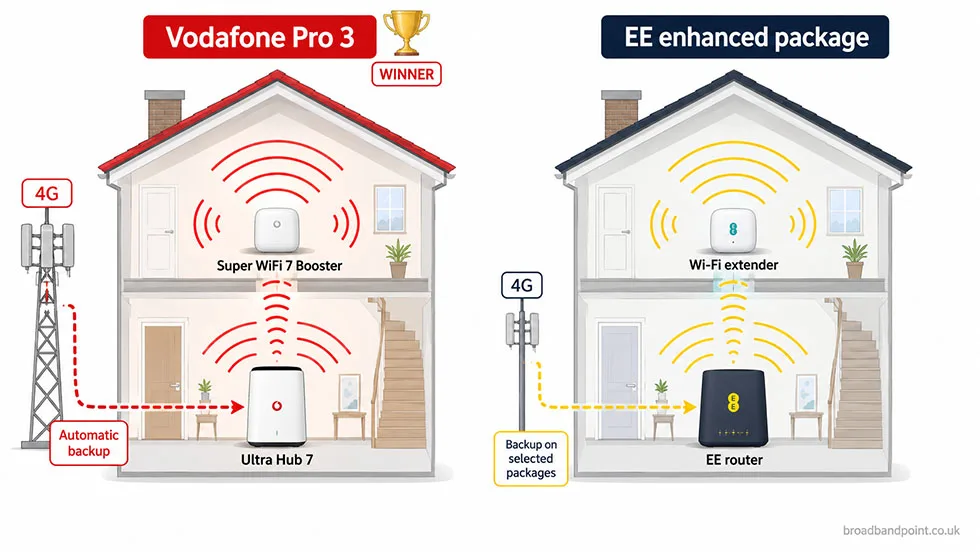
Both providers offer enhanced Wi-Fi 7 equipment. EE supplies the tri-band Smart Hub 7 Pro with selected faster packages, while Vodafone includes the Ultra Hub 7 and Super WiFi 7 Booster with Pro 3.
Vodafone Pro 3 customers receive the Ultra Hub 7 with Wi-Fi 7. EE’s faster and enhanced packages can include the Smart Hub 7 Pro and a Wi-Fi extender.
Whole-home Wi-Fi and broadband backup
Winner: Vodafone
Vodafone Pro 3 combines the Ultra Hub 7, a Super WiFi 7 Booster and automatic 4G broadband backup. The mobile connection activates when the fixed broadband service fails, helping connected devices remain online during an outage.
EE offers Wi-Fi extenders, Wi-Fi management features and connectivity backup with selected enhanced packages. Vodafone wins because Pro 3 brings its whole-home Wi-Fi equipment and mobile backup into one clearly defined broadband package.
Neither provider’s standard router guarantees maximum wireless speed in every room. Wall construction, interference and router placement affect Wi-Fi performance.
Price and contract terms
Winner: Vodafone
Both providers mainly use 24-month contracts. Vodafone currently wins on total package cost across several comparable full-fibre speeds and does not charge a setup fee on the deals listed above.
EE applies a larger fixed annual price increase. Customers should compare the full contract cost after setup fees, scheduled increases and rewards instead of relying only on the starting monthly charge.
EE and Vodafone can each contribute up to £200 towards eligible switching costs when a customer leaves another broadband provider early.
Customer service
Winner: EE
EE recorded six complaints per 100,000 fixed-broadband customers during the first quarter of 2026. Vodafone recorded eight complaints per 100,000 customers during the same period.
Both figures remain below several large broadband providers, but EE’s lower complaint rate gives it the win.
EE customers also benefit from the provider’s close relationship with BT, including access to BT engineers and broadband systems. Vodafone uses its own customer-service operation while relying on the relevant network operator for physical line repairs.
Social tariffs
Winner: Vodafone
Vodafone offers Fibre 2 Essentials to customers receiving eligible benefits. It comes with a 12-month contract, no annual in-contract price increase and no early termination charge.
EE does not offer an EE-branded fixed-broadband social tariff. Eligible EE customers can move to BT Home Essentials, although this means changing provider and broadband package.
Vodafone is therefore the simpler option for eligible customers who want a reduced-price broadband package under the same brand.
EE or Vodafone Broadband verdict
Winner: Vodafone
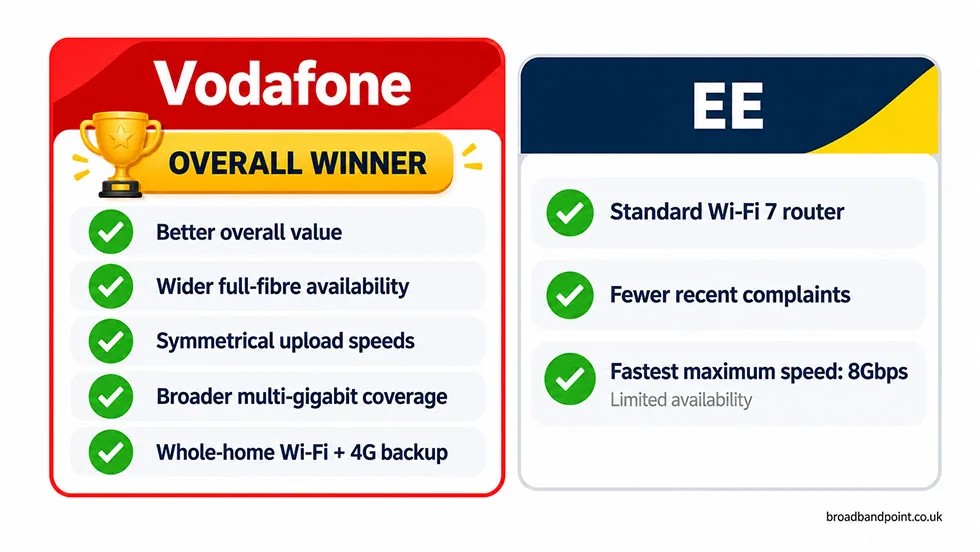
Vodafone is the better broadband provider for most households. It combines competitive costs, wider full-fibre availability and symmetrical upload speeds in supported areas. Its Pro 3 package is also better for customers who want whole-home Wi-Fi equipment and automatic broadband backup.
Choose EE if router technology and customer service are your priorities. Its standard Wi-Fi 7 router is better than Vodafone’s standard Power Hub, and EE recorded fewer recent broadband complaints.
EE also has the fastest maximum download speed, although its 8Gbps service remains available in very few areas. Vodafone’s multi-gigabit packages are available across a wider selection of full-fibre networks.
Frequently asked questions
If EE and Vodafone both use Openreach, is the broadband service the same?
No. They use the same fibre cable and Openreach optical network terminal, but each provider supplies its own router, network routing, customer service and optional Wi-Fi features.
Download speeds will be similar on equivalent Openreach packages. EE currently offers slightly faster upload speeds at the main 150Mbps, 500Mbps and 900Mbps speed points.
Can customers choose which full-fibre network Vodafone uses?
Customers do not normally receive a choice of wholesale network during checkout. Vodafone selects the available service after checking the postcode and premises.
Check the stated upload speed before ordering. An upload speed equal to the download speed indicates a symmetrical connection, while a lower upload speed normally indicates an Openreach package.
Will switching require a new fibre cable or optical network terminal?
A switch between EE and Vodafone on Openreach full fibre will normally reuse the existing fibre cable and optical network terminal.
Vodafone may need to install a separate cable and terminal if the new service uses CityFibre, Community Fibre or another network. A faster multi-gigabit package can also require updated equipment.
Does the minimum guaranteed speed apply to Wi-Fi in every room?
No. The minimum guaranteed speed normally applies to the broadband connection reaching the router, not the wireless speed received throughout the home.
Whole-home Wi-Fi guarantees form part of separate enhanced packages and have their own conditions. Poor room-to-room Wi-Fi does not automatically mean the broadband line has fallen below its guaranteed speed.
Can customers use an existing mesh system or third-party router?
EE permits compatible third-party routers. Full-fibre customers need a router with an Ethernet WAN port and the correct PPPoE settings. Some EE features, including Digital Home Phone, Wi-Fi extenders and connectivity backup, require an EE or BT hub.
Vodafone permits an approved third-party router on eligible standard broadband packages and supplies the required login details on request. Customers using Pro broadband, Digital Voice or 5G broadband must use Vodafone’s router. Both providers can ask customers to reconnect the supplied router before investigating a fault.