
5G broadband is now a serious alternative to slower fixed-line broadband. If your address still only gets ADSL or part-fibre speeds, a good 5G connection can deliver a significant upgrade without a landline, engineer visit or long wait for installation.
That said, 5G home broadband is not automatically better than fibre. In the right postcode it can be quick, flexible and cost-effective. In the wrong postcode it can be less consistent than a good full fibre service and harder to judge before you try it.
The right way to shop for 5G broadband is simple. Start with coverage at your exact address, then compare data allowance, contract length, router quality and the full cost over the minimum term.
Check Broadband in Your Area
5G home broadband explained
5G broadband uses a SIM card inside a router or hub in your home. That hub connects to the nearest mobile mast, then creates a Wi-Fi network for your phones, TVs, laptops, games consoles and smart home kit.
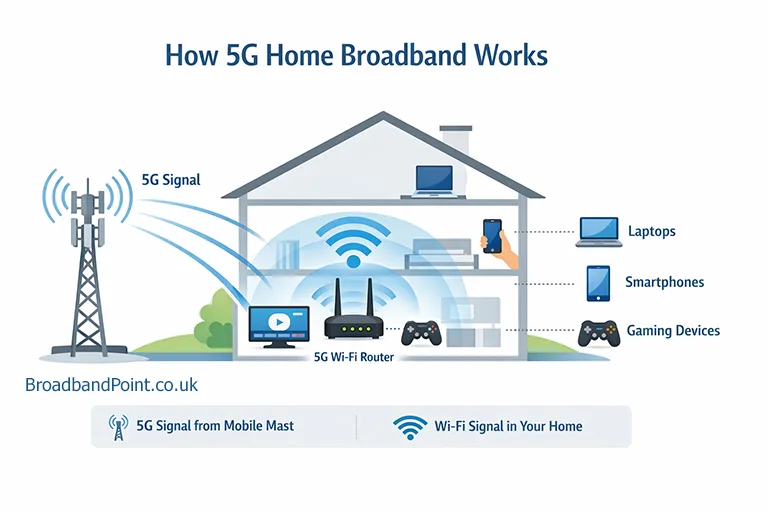
It is different from fixed broadband because it does not use a landline or fibre cable into the property. It is also different from a pocket hotspot because the main products in this category are intended to work as a full home connection, not just a travel gadget.
The main UK options fall into two groups.
- The first group is dedicated home broadband products such as Three 5G Home Broadband, Vodafone GigaCube and EE’s Smart 5G Hub 7 Pro. These are the closest alternatives to normal home broadband.
- The second group is 5G mobile broadband routers that can also be used at home. O2 sits in this category at the moment. O2 does not offer home broadband as O2, but it does offer 5G mobile routers that can work as a home connection.
5G broadband versus fibre broadband
The biggest selling point for 5G home broadband is speed without installation. Three says its 5G home broadband offers an average 150Mbps download speed. Vodafone says its 5G GigaCube typically delivers average speeds between 150Mbps and 200Mbps. EE says its Smart 5G Hub 7 Pro offers average 146Mbps 5G speeds.
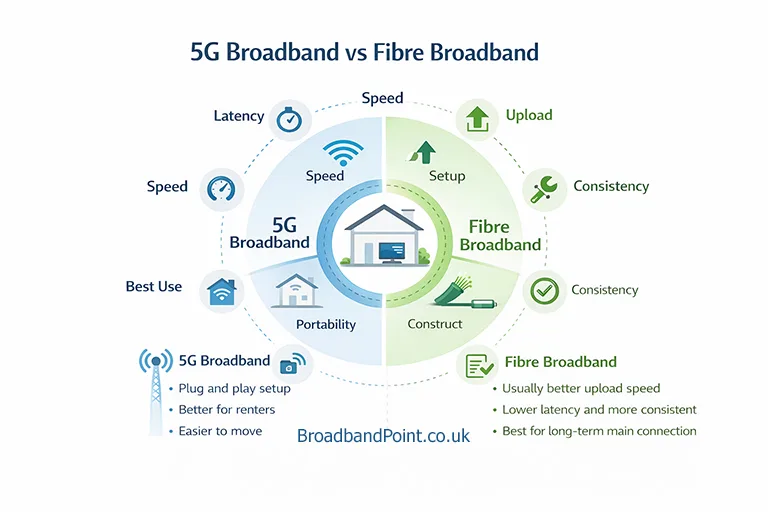
Those figures are strong enough to beat many FTTC packages. They are not enough to beat faster full fibre services. Virgin Media’s M125 is currently £23.99 a month with an average 132Mbps download speed, while Vodafone full fibre starts from £26 a month and goes much higher if you need more speed.
The main difference is consistency. Full fibre still gives a more predictable connection because it is not affected in the same way by indoor signal strength, local mast load or router placement. If you work from home every day, upload large files, rely on cloud backups or play fast-paced online games every evening, full fibre remains the safer first choice where it is available at a good price.
Upload speed is another dividing line. 5G can offer respectable uploads, but the best full fibre services remain stronger if upload performance matters just as much as download speed.
Setup is where 5G wins. You plug the hub in, place it in the best position, and connect your devices. There is no engineer visit and no need to wait for a line to be activated.
Price is more mixed. Some 5G broadband deals are cheaper than fibre. Some are not. The lower-cost 5G offers from Three and Vodafone are very competitive. Premium options from EE and specialist providers cost more.
Advantages of 5G broadband
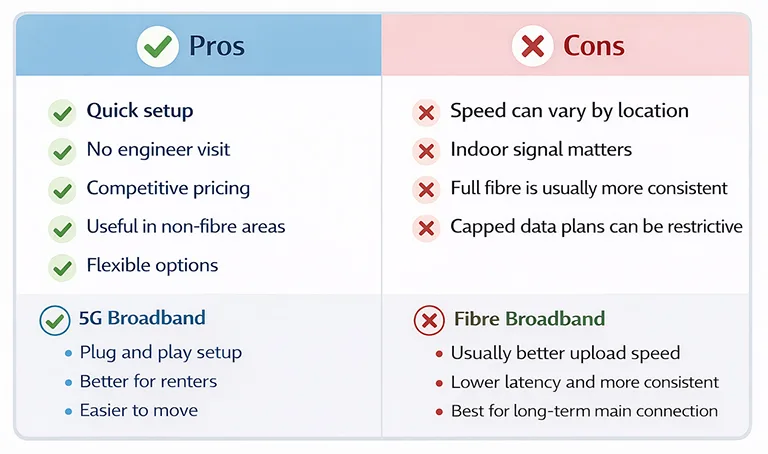
The first advantage is fast activation. If you need broadband quickly, 5G is one of the easiest ways to get online. Most services are delivered ready to plug in and use.
The second advantage is speed in the right area. A good 5G signal can comfortably cope with UHD streaming, remote working, video calls, smart TVs and several people online at once.
The third advantage is flexibility. This matters if you rent, move often or do not want to wait for a fixed-line installation. Vodafone even offers a 30-day GigaCube option, although it costs much more than its 24-month plan.
The fourth advantage is value. Three’s live comparison-site deals are among the cheapest ways to get a main home connection with unlimited data. Even Three’s standard direct plans remain competitive compared with many fixed broadband packages.
The fifth advantage is convenience in areas with poor fixed broadband. If your address is stuck with slow copper broadband and no full fibre, 5G can be a much better option than waiting indefinitely for network upgrades.
Limits to keep in mind
5G broadband is only as good as the signal at your property. A postcode with strong outdoor coverage can still give weaker indoor results if thick walls, nearby buildings or local geography reduce the signal inside.
Performance can also dip at busier times. A mobile mast is shared capacity, so speeds are more likely to change than on a good full fibre line.
Router placement matters much more than it does with fixed broadband. Moving the hub from one side of the room to another, or closer to a window, can change the result.
Data allowance also matters. For a main home connection, unlimited data is the safest choice. A capped plan can disappear quickly once you add 4K streaming, game downloads, cloud photo backups and software updates.
Best 5G home broadband providers in the UK
The UK consumer market for true 5G broadband is still quite small, so this list includes the main dedicated home broadband brands and the strongest home-use alternative.
Three
Three is the best all-round 5G home broadband provider for most people.
Its standard direct 5G Broadband plans are currently listed in the April 2026 price guide at £34 a month on a 12 month contract or £29 a month on a 24 month contract, both with unlimited data and no upfront cost. Three says the service offers an average 150Mbps download speed.
Three also offers one of the most interesting products in the market: the 5G Outdoor Hub. This is £21 a month on a 24 month contract and includes unlimited data plus an eero 6 router indoors. It is especially useful for homes that struggle to get a strong 5G signal inside but can get a better signal outside.
Why it stands out:
- Unlimited data across its home broadband range
- Good value on standard plans
- One of the strongest current deal markets through comparison sites
- Outdoor Hub option for harder properties
- 30-day money-back guarantee
Best for: value, unlimited usage and homes with mixed indoor signal conditions.
Vodafone
Vodafone is the best choice if you want more contract flexibility.
Its 5G GigaCube Unlimited plan is currently £21 a month with £15 upfront on a 24 month contract. Vodafone also offers a 30-day Unlimited version at £60 a month with £150 upfront. Vodafone says 5G GigaCube delivers average speeds of 150Mbps to 200Mbps and can connect up to 64 devices.
Vodafone also offers a 200GB option, but for a full home connection the Unlimited plan makes much more sense.
Why it stands out:
- Strong official pricing on the 24 month unlimited plan
- A genuine 30-day option for short-term use
- Clear average speed guidance
- Good device capacity for busy homes
Best for: people who want unlimited data with a choice of long or short contracts.
EE
EE is the premium end of the 5G home broadband market.
Its Smart 5G Hub 7 Pro offers average 146Mbps 5G speeds, Wi-Fi 7 tri-band, two LAN ports and capacity for more than 100 devices. ThinkBroadband currently lists EE’s home-ready 5G pricing at £45 a month for 500GB of data, while Broadband Genie places EE’s current home 5G range between £21 and £50 a month depending on plan and setup costs.
This is a more expensive route into 5G home broadband, but the hardware is stronger than the cheaper options and the package feels closer to a home-first broadband service than a basic mobile router.
Why it stands out:
- More capable hub than most rivals
- Wi-Fi 7 hardware
- Good option for larger homes
- Strong home-network features
Best for: larger households and buyers who are happy to pay more for a stronger hub.
National Broadband
National Broadband is the best specialist option.
Its ultrafast 5G broadband plans start from £39.99 a month, with typical download speeds between 80Mbps and 210Mbps. It also offers a 30-day money-back guarantee, no mid-contract price rises and a network-selection approach that can be very helpful in awkward postcodes.
This provider is particularly useful if your property is hard to serve and you want a company that checks all four UK mobile networks rather than tying you to just one.
Why it stands out:
- Uses all four UK mobile networks to find the best local option
- 30-day money-back guarantee
- No mid-contract price rises
- A better route for rural and semi-rural properties
- Can recommend equipment for harder signal conditions
Best for: difficult postcodes, rural homes and buyers who want more guidance than a standard self-serve order process.
O2
O2 is the fifth entry with an important caveat.
O2 does not offer home broadband as O2. Instead, it offers 5G mobile broadband routers that can be used at home. Its current range includes routers such as the Netgear Nighthawk M3 and Netgear Nighthawk M7 Pro on unlimited-data plans.
This means O2 is better treated as a home-use alternative rather than a direct rival to Three Home Broadband or Vodafone GigaCube. It is still worth considering if you want a connection you can use at home and also take away with you.
Why it stands out:
- Portable 5G router options
- Unlimited-data router plans available
- A good choice if portability matters as much as home use
Best for: people who want one 5G router for both home use and travel.
Top 5 5G home broadband deals
These are the standout current deals based on price, usability and who they suit best.
1. Three 5G Unlimited Home Broadband – 24 months
This is the best value deal in the market at the moment. Current comparison listings show it from £15 a month with zero upfront cost, average 150Mbps speeds, unlimited data and next-day delivery.
This is the clearest low-cost entry point into true 5G home broadband if Three coverage is strong at your address.
2. Vodafone GigaCube Unlimited – 24 months
Vodafone’s direct Unlimited 24 month GigaCube plan is £21 a month with £15 upfront. It combines straightforward pricing, unlimited data and average 150Mbps to 200Mbps speeds.
This is one of the best direct-from-provider deals for buyers who want an official offer without depending on a short-term comparison promotion.
3. Three 5G Outdoor Hub – 24 months
Three’s Outdoor Hub is £21 a month with unlimited data and an included eero 6 router. It is a particularly good deal for households where a normal indoor hub does not pull in the best signal.
This is not the cheapest Three option, but it can be the best value if signal quality is your main obstacle.
4. National Broadband Ultrafast 5G
National Broadband starts from £39.99 a month and includes a 30-day money-back guarantee with no mid-contract price rises.
This is the best specialist deal for buyers who care more about getting the right network for their property than chasing the lowest monthly cost.
5. EE Smart 5G Hub 7 Pro
EE’s Smart 5G Hub 7 Pro is the premium pick. Current market listings place the 500GB plan at £45 a month, and the hub itself adds better home-network features than the cheaper alternatives.
This makes most sense for larger households that want a more capable router and are prepared to pay more for it.
Choosing the right 5G broadband
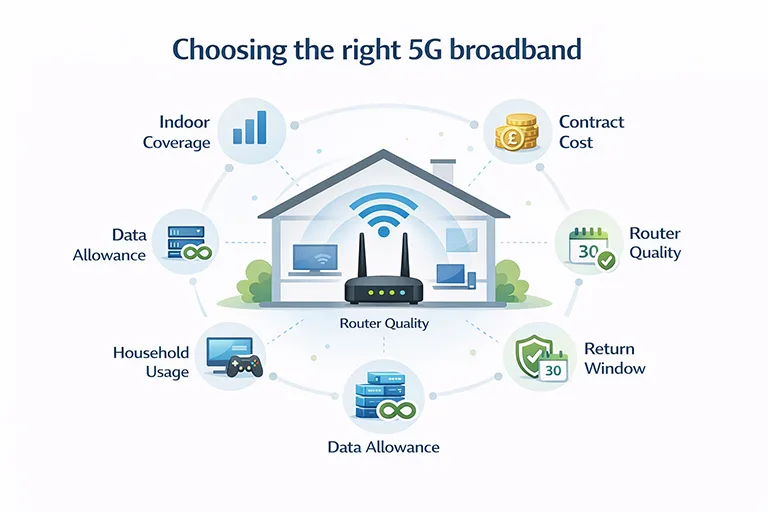
Start with coverage at your exact address
This matters more than any advertised speed figure. Check indoor 5G coverage, not just outdoor coverage. If you only have good outdoor signal, look at an outdoor solution such as Three’s Outdoor Hub or a specialist provider that can recommend different equipment.
Choose unlimited data unless you are a very light user
A 200GB or 500GB plan can be enough for some homes, but they are much easier to outgrow than many people expect. Streaming, console updates, cloud backups and working from home can use far more data than basic browsing.
Check the full contract cost
Do not look only at the opening monthly price. Some deals include an upfront fee, some have annual increases and some comparison promotions change after a fixed period. Work out the real monthly average across the minimum term.
Take the router seriously.
On 5G broadband, the hub is doing two jobs. It has to bring in the mobile signal and distribute Wi-Fi around your home. Better hardware can make a clear difference, especially in larger properties.
Think about your household usage.
If two people work from home, several TVs stream every evening and you download large files often, look for unlimited data and a stronger hub. If you mainly browse, stream a bit and want broadband quickly, a cheaper package will often be enough.
Use a return window where one is available.
This is one of the biggest advantages of the category. Three offers a 30-day money-back guarantee. National Broadband also offers a 30-day money-back guarantee. These trial periods are very useful because 5G performance is so location-dependent.
Our advice
For most people, Three is the best place to start.
It offers the strongest balance of price, unlimited data and product choice. Its standard 5G Broadband packages are competitive, and the Outdoor Hub gives it a useful edge for homes with weaker indoor reception.
Vodafone is the best direct alternative if you want a clear official unlimited package and the option of a 30-day contract.
EE is the premium option. If you want stronger home-network hardware and do not mind paying more, EE is worth considering.
National Broadband is the smart specialist choice if your postcode is difficult and you want help finding the best network, not just the cheapest router.
O2 is only worth considering if portability matters. It does not currently offer a dedicated O2 home broadband service.
If good full fibre is already available at your address for a similar monthly cost, full fibre remains the better long-term main connection for consistency and upload performance.
Conclusion
5G home broadband can be an excellent replacement for slow fixed-line broadband, but only when the mobile signal at your property is good enough.
The best way to choose is to work in this order: check coverage, choose unlimited data if this will be your main connection, compare the full contract cost, then look closely at the router.
If you want the best current all-round option, start with Three. If you want a flexible direct deal, look at Vodafone. If you want a more premium hub, consider EE. If your postcode is difficult, National Broadband is one of the best places to check first.
For homes with strong full fibre availability, fibre still keeps the edge. For homes with poor fixed broadband and good 5G coverage, 5G broadband is now a very serious option.