
Rise Fibre is one of a growing number of alt-net full fibre broadband providers with competitive pricing and solid customer satisfaction scores. Rather than relying on a single network, it draws on three wholesale networks — Openreach (which currently reaches approximately 19 million UK premises), CityFibre, and its own 4th Utility infrastructure — allowing it to serve homes across England, Wales, and Scotland.
The specific plans available to you and the upload speeds you receive depend on which network serves your address.
Rise Fibre Broadband Checker
Pros and Cons
| Pros | Cons |
|---|---|
| Very competitive pricing, especially at higher speeds | Openreach plans have lower upload speeds |
| Symmetrical speeds on CityFibre and 4th Utility | £3 annual March price increase on all fixed-term contracts |
| Three-network approach means wider coverage | No managed mesh Wi-Fi add-on |
| Free activation on all plans | |
| 4.5/5 Trustpilot from 3,500+ reviews | |
| 12 or 24-month contract options |
Packages and Pricing in 2026
24-Month Contracts
| Speed | First 6 Months | Thereafter |
|---|---|---|
| 150Mbps | £17.99/mo | £27.99/mo |
| 200Mbps | £23.99/mo | £33.99/mo |
| 300Mbps | £26.99/mo | £36.99/mo |
| 500Mbps | £27.99/mo | £37.99/mo |
| 900Mbps | £28.99/mo | £38.99/mo |
All 24-month plans include a £10/month discount for the first 6 months.
12-Month Contracts
| Speed | Monthly Cost |
|---|---|
| 150Mbps | £33.00 |
| 200Mbps | £37.00 |
| 300Mbps | £39.00 |
| 500Mbps | £41.00 |
| 900Mbps | £46.00 |
Rise Fibre offers a clean range of full fibre plans with unlimited data, free activation, and symmetrical speeds where the network allows. In select postcodes on CityFibre, speeds of up to 2.3Gbps are also available. No contract broadband option (30 days) is also available.
Who Should Switch to Rise Fibre?
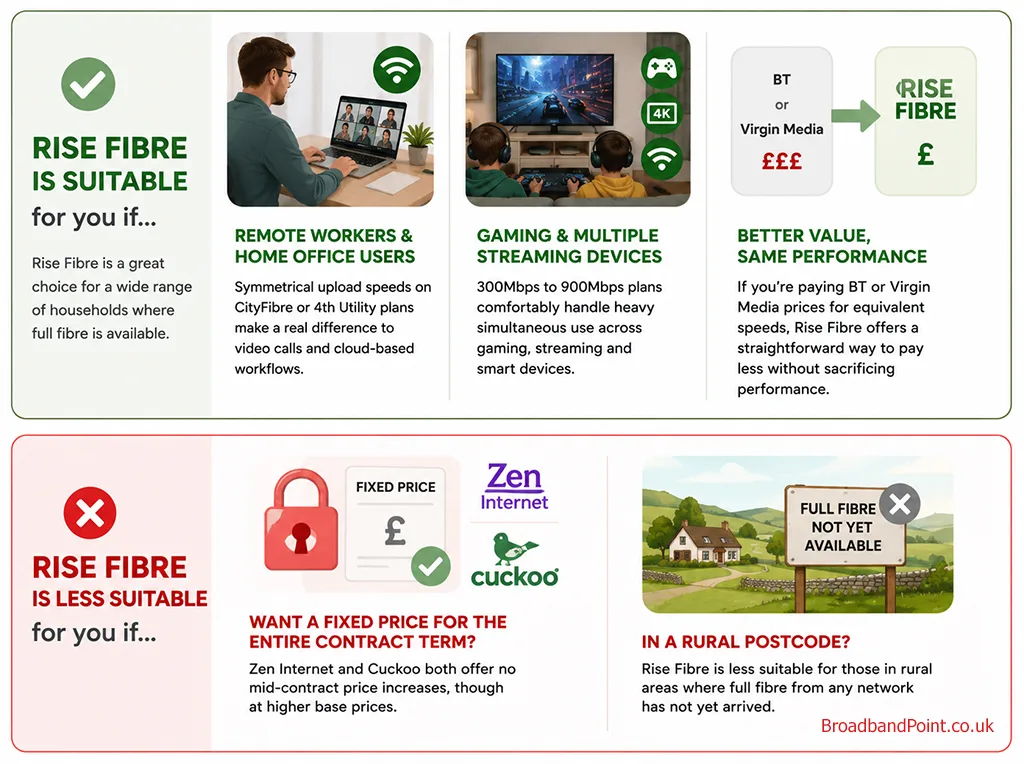
Rise Fibre is a good choice for a broad range of households where full fibre is available.
It is particularly well suited to remote workers and home office users, where symmetrical upload speeds on CityFibre or 4th Utility plans make a real difference to video calls and cloud-based workflows. Gaming households and families with multiple streaming devices will find the 300Mbps to 900Mbps plans comfortably handle heavy simultaneous use. And for anyone paying BT or Virgin Media prices for equivalent speeds, Rise Fibre offers a straightforward way to pay less without sacrificing performance.
It is less suitable for customers who want a fixed price for the entire contract term — Zen Internet and Cuckoo both offer no mid-contract price increases, though at higher base prices — or for those in rural postcodes where full fibre from any network has not yet arrived.
Speeds and WiFi Router
On CityFibre and the 4th Utility network
- Speeds are fully symmetrical — upload speed is equal to download speed on all plans
- A 900Mbps plan delivers 900Mbps both ways
- Ideal for video calls, cloud backups, and large file uploads
On the Openreach network
- Plans are asymmetric — download speeds are fast, but upload speeds are lower
- The 900Mbps plan offers around 110Mbps upload
- Still considerably faster than a standard FTTC connection, but a significant step down from the symmetrical speeds available on CityFibre and 4th Utility
Router
Rise Fibre supplies an Icotera router with all plans. The model you receive depends on your package:
- i4880 (Wi-Fi 6) — supplied with higher-speed packages
- i4850 — supplied with entry-level plans
| Feature | Icotera i4880 (Wi-Fi 6) | Icotera i4850 |
|---|---|---|
| Wi-Fi Standard | Wi-Fi 6 (802.11ax) | Wi-Fi 5 (802.11ac) |
| Wi-Fi Bands | Dual-band 2.4GHz + 5GHz | Dual-band 2.4GHz + 5GHz |
| Antenna Configuration | 8×8 on 5GHz + 4×4 on 2.4GHz | 4×4 on 5GHz + 2×2 on 2.4GHz |
| Maximum Wi-Fi Speed | Up to 9.8Gbps link rate | Up to 1700Mbps (5GHz) + 300Mbps (2.4GHz) |
| MU-MIMO | Yes | Limited (Wi-Fi 5 Wave 2) |
| OFDMA Support | Yes | No |
| 1024-QAM | Yes | No |
| WAN Port | 2.5Gbps WAN | Gigabit WAN |
| LAN Ports | 1×2.5G LAN + 2×1G LAN | 4×1G LAN |
| Mesh Support | Yes | No |
| VoIP / Phone Ports | Available on i4883 model | 2 phone ports |
| WPA3 Security | Supported | WPA2 only |
| IPv6 Support | Yes | Yes |
| Designed For | High-end fibre broadband and heavy Wi-Fi usage | Standard home broadband usage |
| Best For | Gigabit broadband, gaming, remote work, many devices | Smaller households and moderate usage |
| Typical Coverage | Very strong due to 12 antennas | Standard coverage |
| Power Consumption | Higher | Lower |
| Bridge Mode | Supported by ISP configuration | No |
| Guest Network | Supported | No |
| Parent Controls | ISP dependent | No |
Main Differences
- The i4880 is a much newer and more powerful router designed for gigabit and multi-gig fibre broadband.
- Wi-Fi 6 on the i4880 improves speed, latency, efficiency and performance with many connected devices.
- The i4850 is better suited for normal browsing and smaller households, while the i4880 is built for heavy streaming, gaming and home office usage.
- The i4880 also includes 2.5Gbps networking, mesh support and WPA3 security, which the i4850 lacks.
There is no managed mesh Wi-Fi add-on available. Customers in larger properties who need extended wireless coverage will need to source and set up their own solution.
Installation and Switching
Where a full fibre line is already in place, you can simply connect the supplied router on your activation date. Where a new line needs to be run, Rise Fibre arranges an engineer visit, typically within 5 to 10 working days of your order.
You have a 14-day cooling-off period after signing up. If you need to leave before your contract ends, early termination fees apply based on the remaining months of your agreement.
Customer Service
Rise Fibre holds a Trustpilot rating of 4.5 out of 5 stars from over 3,500 reviews — a strong result that compares favourably with major providers like Virgin Media and Sky, both of which have significantly lower scores on the same platform.
Positive reviews consistently highlight smooth switching experiences, professional installation engineers, and helpful support staff. A smaller number of reviewers mention longer wait times when contacting support, particularly in areas where the network rollout is more recent.
Unresolved complaints can be escalated to the Ombudsman Services (Communications Ombudsman), which is the standard independent scheme for UK broadband disputes.
Rise Fibre vs other providers
| Provider | ~900Mbps Monthly Cost | Symmetrical? | Contract |
|---|---|---|---|
| Rise Fibre | £22.99 intro / £32.99 standard | Yes (CityFibre/own) | 12 or 24 months |
| Hyperoptic | £35–40 | Yes | 12 or 24 months |
| Vodafone (CityFibre) | £34–37 | Yes | 24 months |
| BT Full Fibre 900 | £49 | No | 24 months |
| Virgin Media Gig1 | £44–52 | No | 18 months |
vs Hyperoptic: Both providers now apply annual price increases following Hyperoptic’s June 2025 change of policy. Rise Fibre’s introductory pricing is lower for the first eight months, and its multi-network coverage means it is available to a much wider range of households. Hyperoptic remains predominantly available in large urban apartment buildings.
vs BT: BT’s full fibre plans cost considerably more at the 900Mbps level and offer lower upload speeds on Openreach. Rise Fibre costs less and, where CityFibre or 4th Utility serves your address, offers a symmetrical connection that BT cannot match at equivalent pricing.
vs CityFibre resellers (Vodafone, Sky, Zen): If you are on CityFibre, you have multiple provider options. Zen Internet offers a no-mid-contract-price-rise guarantee, which Rise Fibre cannot match. Sky’s pricing is broadly similar to Rise Fibre’s standard rate but without the introductory discount structure. Rise Fibre’s introductory deal costs less than most CityFibre resellers for the first eight months.
Final Verdict
Rise Fibre is one of the better-value full fibre options available in the UK in 2026. Its multi-network coverage makes it accessible to far more households than most alt-nets, its Trustpilot scores suggest it delivers on service quality, and its pricing — particularly on 500Mbps and 900Mbps plans — undercuts the major national providers by a meaningful margin.
The two things to go in with open eyes on are the introductory discount structure (the first eight months are very attractively priced, but the standard rate is what you’ll pay for the majority of a 24-month contract) and the £3 annual March increase, which applies to all fixed-term plans.
Bottom line: if Rise Fibre covers your postcode and you want fast, reliable full fibre without overpaying, it belongs on your shortlist.