
If you’re in the middle of a move, renting somewhere short-term, or simply not ready to tie yourself to an 18 or 24-month deal, no contract broadband is well worth a look. The idea is straightforward enough: you pay on a rolling monthly basis, give notice when you want out, and sidestep the early exit charges that can catch you out on a long fixed term. The trade-off is equally straightforward: rolling monthly broadband tends to cost more than the cheapest long-term packages.
That means it won’t suit everyone. But for renters, students, people between properties, or anyone who only needs a connection for a limited time, it can be the smarter call. And in 2026, the choice is broader than it used to be, with cable, full fibre and 5G home broadband options all available on a rolling basis.
Top 5 no contract broadband deals
1. Rebel 115 Broadband
Rebel Internet is one of the cheapest ways to get no contract broadband. The speed is ultrafast, it is great for everyday browsing and HD streaming.
2. Hyperoptic — 150Mbps full fibre
Hyperoptic is one of the best no contract full fibre options if it is available at your address. It offers much faster speeds than the cheapest deals, and selected plans come with upload speed equal to the download speed.
3. Community Fibre — 1Gbps
Community Fibre offers short term contract broadband and the 1 Gbps package is the best place to start if you want a good balance of price and speed.
4. BeFibre
BeFibre broadband comes with ultrafast speeds and equal download & upload speeds.
5. Virgin Media M125 broadband
Virgin Media offers M125 on 30-day terms and it usually costs more than the cheapest rolling deals, but the 132Mbps average speed is much faster than entry-level packages from most rivals.
No Contract Broadband Checker
What is no contract broadband?
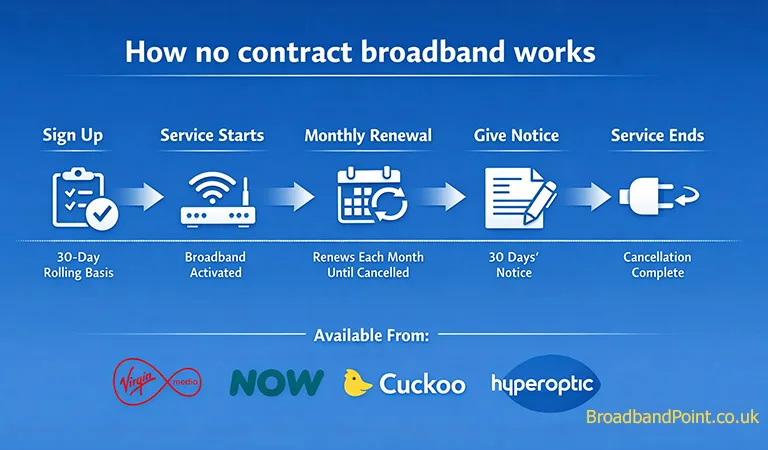
No contract broadband is broadband with no long minimum term. Rather than committing to 12, 18 or 24 months, you take the service on a rolling basis and leave by giving notice. Virgin Media’s no contract broadband runs on a 30-day rolling basis. NOW’s No Contract Plan works in the same way. Cuckoo offers a one-month rolling contract, while Hyperoptic provides monthly rolling options across its full fibre services.
You’ll also see the terms rolling contract broadband and rolling broadband used interchangeably — in plain English, they mean the same thing: a service that renews each month until you cancel. That doesn’t mean you can walk away overnight, though. Most providers ask for 30 days’ notice as standard. Cuckoo is a slight exception: its terms allow you to cancel at the end of any month after the first, provided you give at least two days’ written notice.
Which UK providers offer no contract broadband?
- Virgin Media offers no contract broadband on 30-day terms, with M125, M250, M350 and M500 available.
- NOW Broadband offers a No Contract Plan on rolling monthly terms.
- Hyperoptic offers monthly rolling full fibre broadband, with a choice of broadband-only and broadband-and-phone packages. Selected plans also offer upload speeds equal to the download speed.
- Cuckoo offers one-month rolling broadband alongside its longer contracts.
- giffgaff offers monthly rolling broadband as well as 24-month plans.
- Community Fibre is slightly different. It offers a 30-day rolling option for existing customers at the end of their contract, rather than as a standard new-customer deal. It also costs an extra £4 a month on top of the package price.
Check your postcode to find the availability of these providers in your area.
What do you get with a no contract deal?
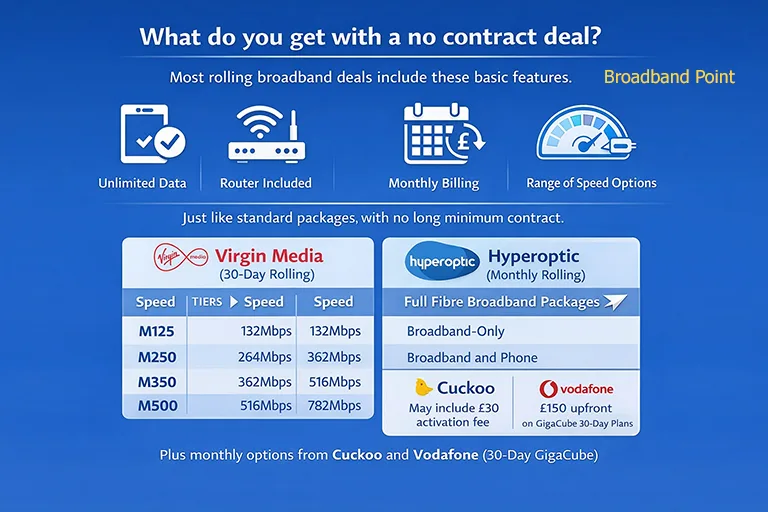
Most rolling broadband packages include the basics you’d expect from any standard deal: unlimited data, a router, monthly billing and a range of speed tiers. Virgin Media’s no contract line-up covers M125, M250, M350 and M500 on its 30-day setup. Hyperoptic’s monthly rolling options come in broadband-only and broadband-and-phone versions.
One thing worth checking before you sign up is whether there’s an upfront cost involved. Some providers include free activation, but not all. Cuckoo’s pricing can include a £30 activation fee if it’s specified in your contract documents. On the wireless side, Vodafone’s 30-day GigaCube plans carry a £150 upfront charge on both the 200GB and Unlimited options — so the flexibility does come at a price there.
It’s also worth paying attention to how speed is described. Ofcom requires providers to show you the average speed you’re likely to see at busy periods — which is a far more useful figure than the headline “up to” number in the advert. When you’re comparing rolling broadband deals, focus on that average speed, check the notice period, and look out for any setup or router charges before you commit.
Who is no contract broadband best suited to?
Rolling broadband is really aimed at people who know a long commitment isn’t for them. Virgin Media describes its 30-day service as a good fit for renters, people mid-move, or anyone who can’t face signing up for two years. Three makes a similar case, pointing to students, people in short-term accommodation and those with seasonal holiday rentals as natural candidates. MoneySavingExpert echoes the same logic — if you’re likely to move soon or you’re living in student digs, a no contract deal makes a lot more sense than locking in for 24 months and paying to escape later.
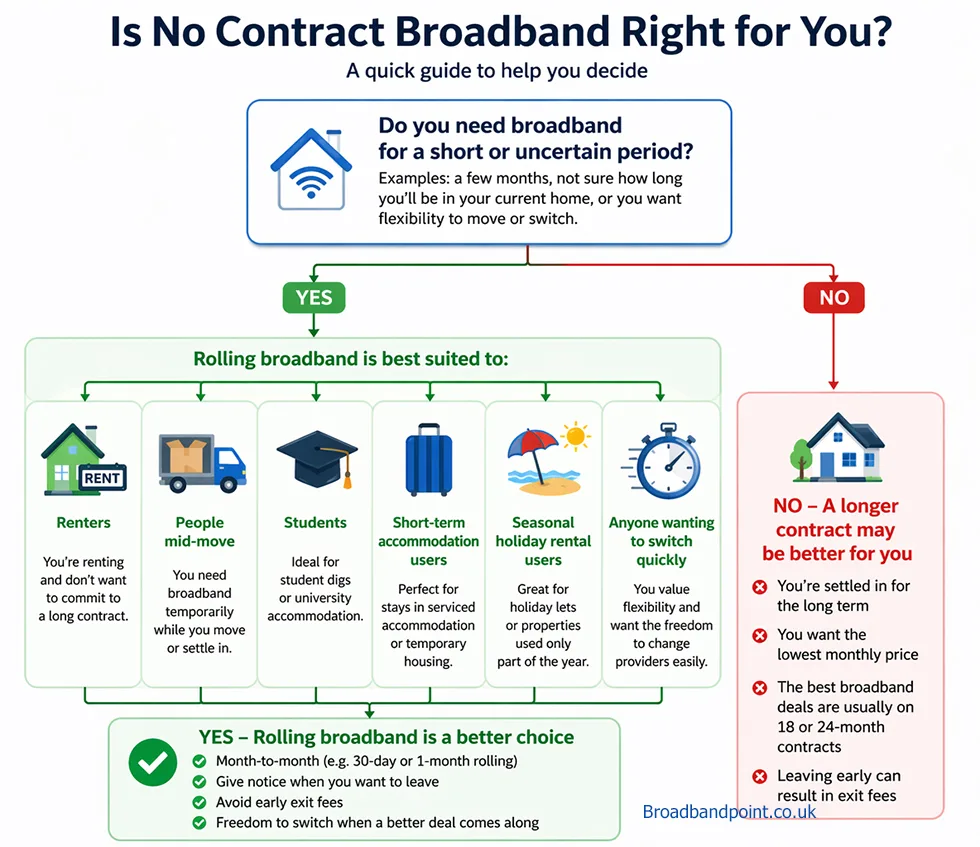
The short version: if your situation is temporary, rolling broadband is almost always the better call. It also suits anyone who wants the freedom to switch quickly. Since September 2024, Ofcom’s One Touch Switch process has made that easier still — fixed broadband customers now only need to contact their new provider to get the ball rolling, which takes most of the friction out of changing.
For a household that’s settled in for the long term, though, the case for no contract broadband is harder to make. Monthly rolling deals tend to cost more, and the sharpest prices are still reserved for 18 and 24-month contracts.
Advantages of no contract broadband
You can leave without a hefty exit fee
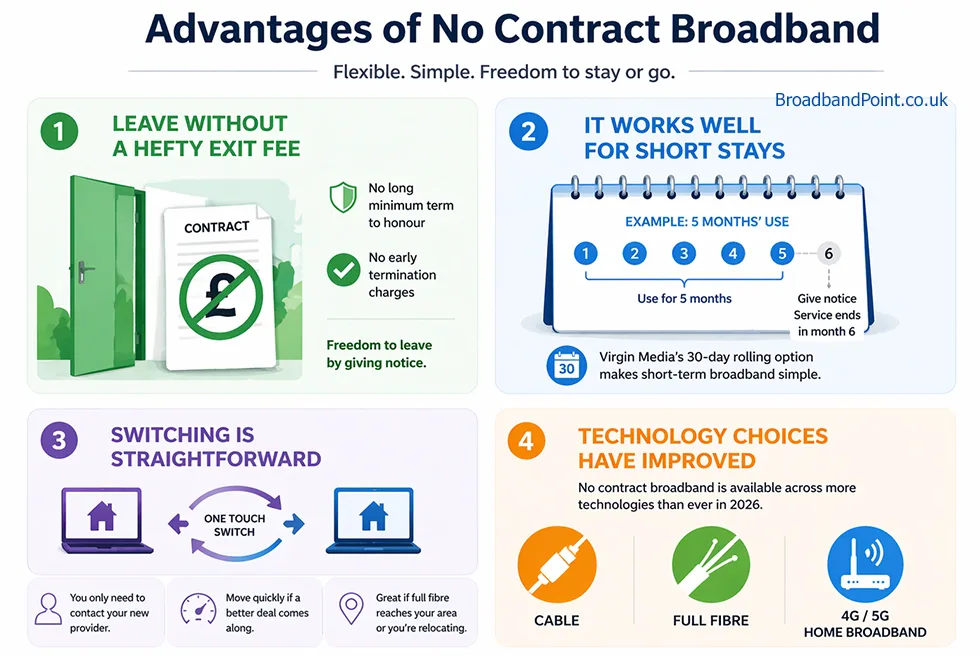
This is the main draw. With rolling broadband, there’s no long minimum term to honour, so you won’t face the kind of early termination charge that can sting on a fixed contract. For many people, that’s reason enough.
It works well for short stays
If you only need a connection for a few months, a rolling deal is far simpler than signing a long contract and trying to unpick it later. Virgin Media makes the point neatly: if you need broadband for five months, you can take its 30-day option and then give notice so the service wraps up in the sixth.
Switching is straightforward
With One Touch Switch now in place, moving to a new provider is simpler than it used to be. A monthly arrangement gives you the flexibility to move on quickly — whether a better deal has come along, a full fibre provider has finally reached your street, or you’re simply relocating.
The technology choices have improved
No contract broadband is no longer confined to older copper-based services. In 2026, you can find rolling deals across cable, full fibre and 5G home broadband. Virgin Media offers 30-day cable packages, Hyperoptic and Cuckoo both have monthly rolling full fibre options, giffgaff offers rolling full fibre plans, and Three covers 4G and 5G home broadband on a one-month basis.
Disadvantages of no contract broadband
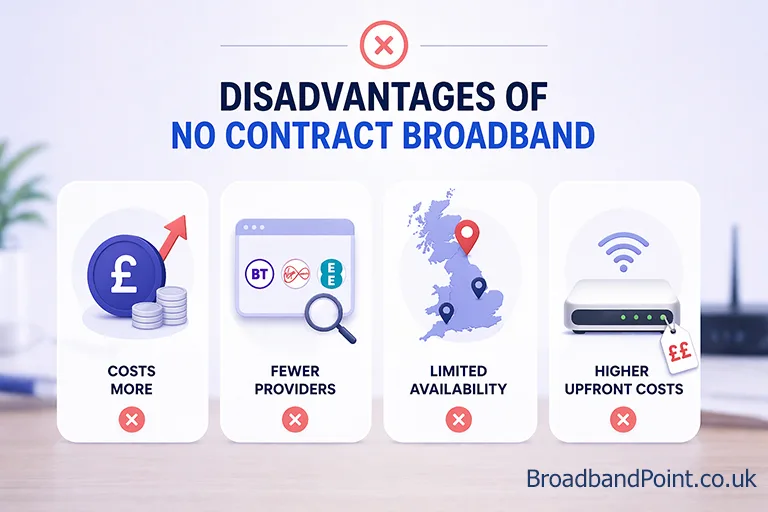
It usually costs more
No contract broadband nearly always costs more each month than a fixed-term deal. The cheapest prices are still tied to 18 or 24 month contracts, so you pay extra for the flexibility.
Fewer providers and deals
There are far fewer no contract options than standard broadband deals. You do not get the same range of providers, speeds or prices that you see with longer contracts.
Availability is limited
Some of the better rolling broadband deals are only available on specific networks. Hyperoptic and Community Fibre are limited to certain areas, and Virgin Media is only available where its cable network is installed.
Upfront costs can be higher
No contract broadband can come with extra upfront costs. Activation fees, router charges or higher setup costs are more common on rolling deals. Wireless options can be even more expensive, with high upfront charges on some 30-day plans.
Alternatives to no contract broadband
5G broadband
If fixed-line no contract broadband is too expensive or not available at your address, 5G home broadband is the main alternative to check.
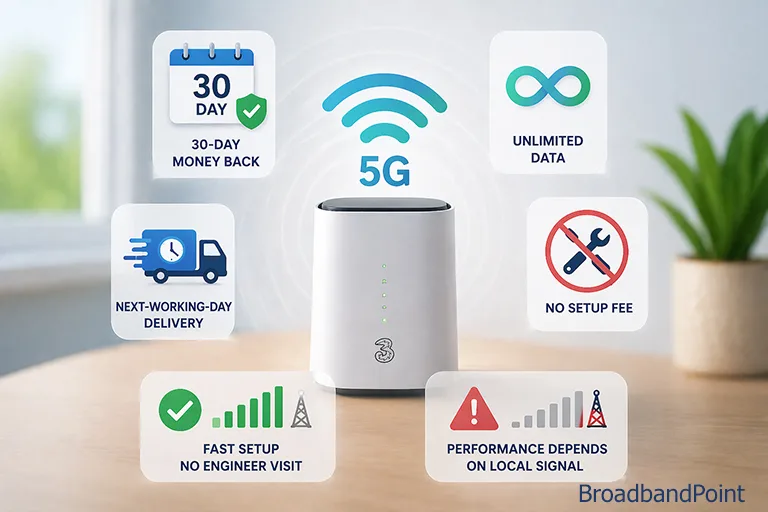
Three Home Broadband is one of the best options here. It offers unlimited data, no setup fee, no landline, next-working-day delivery and a 30-day money-back guarantee. That makes it a very good short-term option.
Vodafone GigaCube is another option, but it is much more expensive on 30-day terms. The Unlimited plan costs £60 a month with £150 upfront, while the 200GB plan costs £40 a month with the same £150 upfront charge.
The main advantage of 5G broadband is speed of setup. There is no engineer visit and no fixed line installation. The downside is that performance depends much more on local mobile coverage, so you need to check signal before you order.
Is no contract broadband worth it?
No contract broadband is a good choice if you only need broadband for a short period. It suits renters, students, people moving home and anyone who does not want a long contract.
If you are staying put and want the lowest monthly price, a fixed-term deal is usually better value. The cheapest broadband deals are still more common on 18 and 24 month contracts.
The best no contract broadband provider depends on what you need.
- Virgin Media is a good choice if you want a big-name provider with 30-day terms.
- Hyperoptic is one of the best options for rolling full fibre where available.
- BeFibre is a good value choice for monthly rolling full fibre and symmetrical speeds.
- Cuckoo is worth checking if you want one-month fixed-line broadband.
- Three Home Broadband is the best alternative if fixed-line no contract deals are limited at your address.