
Full fibre is the best starting point for gaming. It gives you the best chance of lower latency, lower jitter, more consistent upload speed and better overall performance than older part fibre and cable connections.
You do not need a plan with “gaming” in the name to play online well. In the UK, dedicated gaming broadband remains rare. EE is the clearest example of a mainstream provider with a gaming-focused bundle. Most other providers offer standard full fibre packages that are very suitable for gaming when the connection quality and home setup are right.
My quick verdict is straightforward. Community Fibre is the best overall gaming broadband provider where available. EE is the best choice if you specifically want gaming extras. Vodafone is the best premium option for Wi-Fi hardware and backup. Hyperoptic is one of the best city-based providers for equal upload and download speeds. Virgin Media gives you one of the cheapest gigabit options from a major national brand.
Gaming Broadband Checker
Gaming broadband explained
Gaming broadband is not a separate type of broadband. It is usually a standard broadband package that comes with gaming-focused extras such as traffic prioritisation, gaming modes, mesh Wi-Fi, bundled subscriptions or lower-latency features.
The connection itself still matters most. A good full fibre service with low latency and reliable in-home Wi-Fi will usually give you a better gaming experience than a faster package on a weaker connection type or with poor wireless coverage in the house.
That is why the best gaming broadband guide should focus on connection quality first, speed second and bundled extras third.
When a gaming-labelled plan matters
A gaming-labelled plan matters if you want extras that go beyond the line itself.
That includes things such as:
- gaming traffic priority
- geo-filtering or server selection tools
- a stronger router or mesh system
- bundled perks such as Xbox Game Pass
- backup connectivity if your main line fails
For most people, those extras are useful rather than essential. Standard online gaming does not need huge bandwidth. The bigger issue is whether your broadband stays responsive when other people in the home are streaming, downloading or working online at the same time.
A dedicated gaming plan becomes more useful when you play competitively, stream regularly, rely on cloud gaming, use remote play a lot or have a busy home network that needs better traffic management.
Gaming broadband for PS5, Xbox, PC and cloud gaming
PS5 gaming
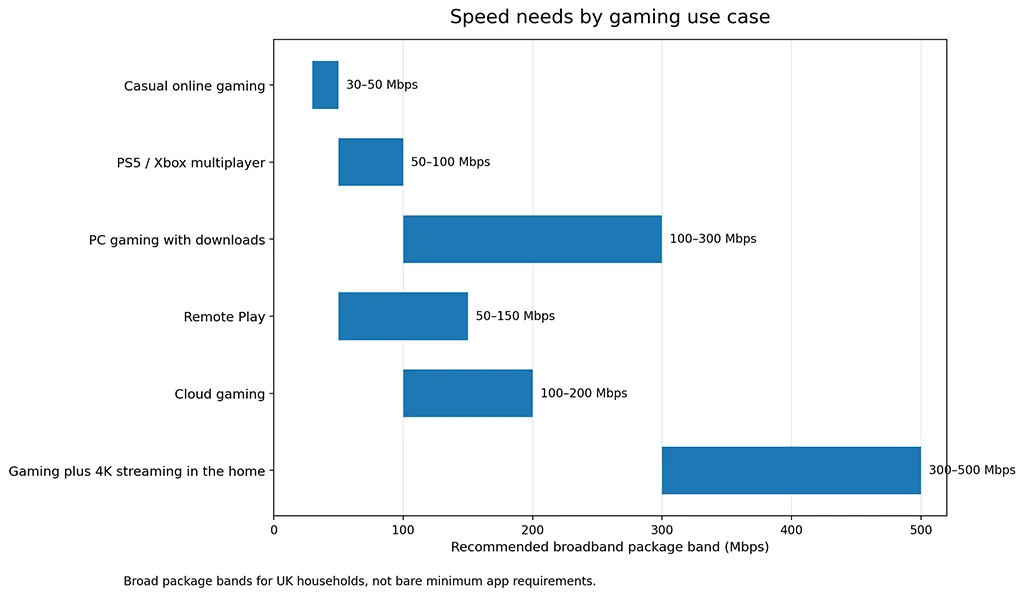
A PS5 does not need massive speed for standard online matches. A good fibre connection with low latency is more important than paying extra for a very fast package. If you also use Remote Play, your connection quality matters more, especially if other devices are active on the network.
For most PS5 homes, 67Mbps to 150Mbps fibre is already enough. A 300Mbps or faster package becomes more useful when several people share the connection, download large games or stream video at the same time.
Xbox gaming
Xbox multiplayer has similar needs. The match itself uses modest bandwidth, but cloud gaming and game downloads place much heavier demands on the line. If you use Xbox Cloud Gaming, a cleaner connection and strong 5GHz Wi-Fi or Ethernet become more important.
A 150Mbps full fibre plan suits most Xbox players. A 300Mbps to 500Mbps service is a better choice for larger households or regular cloud gaming use.
PC gaming
PC gaming benefits from lower latency and faster downloads more than anything else. Large PC games, updates and launcher downloads can take a long time on slower packages, so faster fibre saves time even if the online match itself does not need much bandwidth.
If you stream gameplay, upload clips or use voice chat heavily, upload speed matters a lot more. That is where full fibre with equal upload and download speed becomes especially attractive.
Cloud gaming
Cloud gaming is the most demanding use case in this guide. It needs a clean connection, low latency and enough speed to deliver a live video stream without quality drops.
This is the clearest reason to step up to a faster package. Cloud gaming can benefit from 150Mbps or faster broadband in a busy home, even though the service itself may only need a fraction of that speed. The extra bandwidth helps keep performance consistent when the rest of the household is online.
Specs that matter most
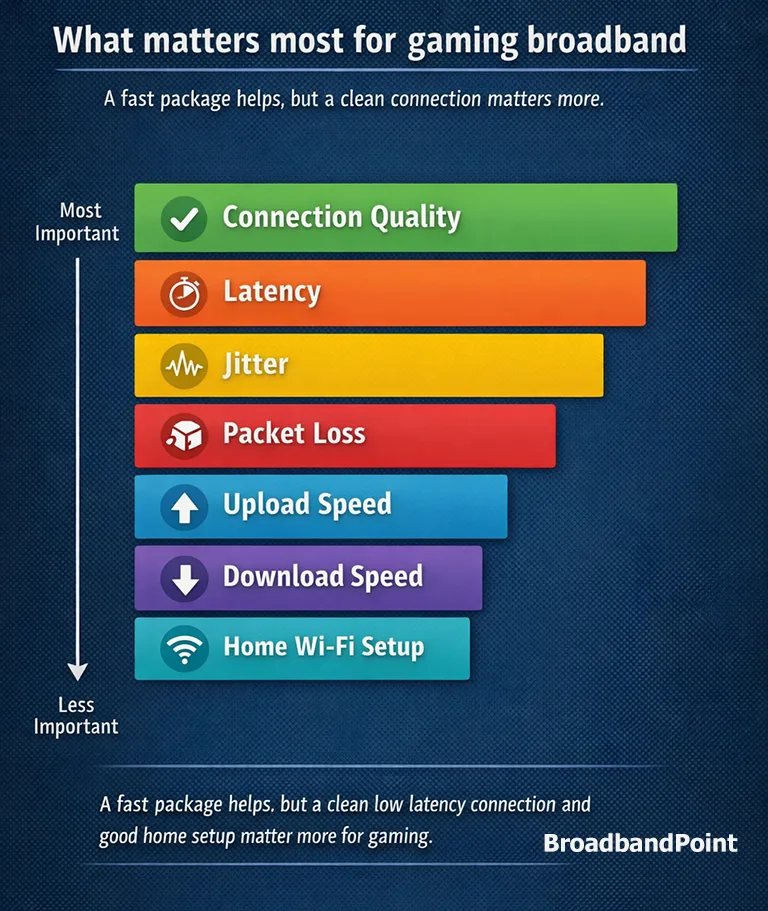
If you are choosing broadband for gaming, focus on these points in this order:
- Full fibre connection type
- Low latency
- Low jitter
- Low packet loss
- Enough speed for the whole household
- Strong upload speed
- Good router placement or Ethernet
- Mesh Wi-Fi if the signal has to travel far
Connection type
Full fibre is the best option where available. It gives you the strongest base for gaming, large downloads, streaming and remote play.
Latency and jitter
These matter more than raw speed once you already have a decent fibre package. Lower latency helps your inputs reach the game server faster. Lower jitter helps keep the connection more consistent during the match.
Speed
Most gamers do not need gigabit broadband just to play online.
As a general rule:
- 67Mbps to 150Mbps suits one gamer or a smaller household
- 300Mbps to 500Mbps is a better target for multi-device homes
- 900Mbps or faster is best for heavy use, very large downloads, streaming, cloud gaming and several active users at once
Upload speed
Upload speed matters for streaming, cloud saves, sending clips, voice chat and remote play. Providers that offer equal upload and download speed have a clear advantage here.
Router and in-home Wi-Fi
A fast package will not fix weak Wi-Fi in the back bedroom or loft. If your gaming room is far from the router, look for a provider that includes mesh hardware, Wi-Fi guarantees or strong router options.
UK gaming broadband market at a glance
The UK market still has very few true gaming broadband packages.
EE stands out because it offers a clear gaming-focused bundle with gaming features and extras. BT, Sky, Virgin Media and Zen all speak to gamers, but they do so through standard broadband packages rather than a separate gaming technology. Community Fibre, Hyperoptic and Vodafone do not rely on heavy gaming branding in the same way, yet some of their actual fibre products are excellent for gaming because the connection quality is so strong.
That is why this guide ranks providers on real gaming suitability rather than marketing language.
Best gaming broadband providers in the UK
Community Fibre
Community Fibre is the best overall gaming broadband provider where available.
It gets the top spot because it combines full fibre, equal upload and download speeds, very aggressive pricing and a clear gaming angle focused on latency, ping and jitter. That makes it excellent for online gaming, streaming, cloud gaming and remote play.
The only real drawback is availability. It is still far less widely available than the biggest national brands.
EE
EE is the best provider if you specifically want gaming extras.
Its Made for Gamers package is the clearest gaming-focused offer from a major UK broadband provider. It adds features such as gaming optimisation tools and bundled gaming perks, which makes it more than just a standard broadband package with a gaming label.
The drawback is price. EE’s dedicated gaming offer is a premium product, so it suits readers who want the extras and are willing to pay for them.
Vodafone
Vodafone is the best premium choice for home networking.
That matters because many gaming problems start inside the home rather than on the line itself. Vodafone Pro packages bring together fast full fibre, newer Wi-Fi hardware, booster options and backup connectivity. That combination is ideal for larger homes where the main issue is Wi-Fi reach rather than broadband speed.
It is not the cheapest route into gaming broadband, but it is one of the most complete premium options.
Hyperoptic
Hyperoptic is one of the best specialist gaming providers in covered buildings and city areas.
Its big advantage is equal upload and download speed across much of its range. That makes it a very good choice for players who stream, upload content or rely on remote play as well as standard online gaming.
Coverage is the limiting factor. If Hyperoptic serves your building, it is one of the best gaming broadband options on the market.
Virgin Media
Virgin Media remains one of the strongest mainstream choices for gamers who want fast downloads at a good price.
Its gigabit deals are often among the cheapest from a major provider, and that makes it attractive for players who download large games regularly. Virgin also puts more effort into gaming messaging than many big rivals, and its higher-end packages include Wi-Fi guarantee options.
Where full fibre and Virgin Media cost a similar amount, I would usually pick full fibre first. Even so, Virgin still earns a place in the top five because the value can be very strong.
Top five deals we recommend
Deal pricing changes by postcode, promotion period and comparison partner. Instead of listing a single figure, these are the price bands the best current deals fall into.
Community Fibre 1Gbps Full Fibre Broadband
Current deal pricing places this plan in the £20 to £25 a month band.
This is the best value gaming deal in the market where available. You get full fibre, very fast downloads and equal upload and download speed, which is excellent for gaming, streaming and remote play.
Virgin Media Gig1
Current deal pricing places this plan in the £24 to £30 a month band.
This is one of the best cheap gigabit deals from a major national provider. It is a very good choice if your main priorities are fast downloads, wide availability and major-brand pricing.
Sky Full Fibre Gigafast
Current deal pricing places this plan in the £25 to £30 a month band.
Sky does not make the main top five provider list in this guide, but this specific deal deserves a place. It is one of the strongest widely available Openreach-based gaming offers for readers who want fast full fibre from a big mainstream brand.
Vodafone Full Fibre 910
Current deal pricing places this plan in the £29 to £35 a month band.
This is the best value Vodafone deal for most gamers. It gives you very fast full fibre at a lower monthly cost than the more premium Pro packages.
EE Full Fibre 900
Current deal pricing places this plan in the £30 to £35 a month band.
This is the best EE deal for most readers because it gives you fast full fibre without the much higher monthly cost of EE’s dedicated gaming bundle.
Best short-contract alternative
Hyperoptic 1Gb on a 12-month contract usually falls in the £29 to £35 a month band.
That makes it one of the best shorter-term gaming broadband options for renters, movers and anyone who does not want a longer contract.
Hardware and setup tips
A better home setup can improve gaming more than a faster package.
Use Ethernet if you can
A wired connection usually gives you lower latency and a more consistent result than Wi-Fi. If your console or PC is close enough to the router, Ethernet is the best option.
Use 5GHz Wi-Fi if you cannot wire in
If you have to use Wi-Fi, connect to the 5GHz band rather than 2.4GHz. It usually delivers better speeds and lower latency at short to medium range.
Choose a provider with mesh or Wi-Fi extras for larger homes
If your gaming room is far from the router, mesh hardware or Wi-Fi guarantee options can help more than simply upgrading your broadband speed.
Keep the router in the right place
Put it in an open, central position if possible. Avoid cupboards, thick walls and corners of the house where the signal has to travel too far.
Check your device ports and cables
If you pay for 900Mbps or faster broadband, make sure your router, cables and device ports can actually deliver that speed.
Online gaming tips
- Use the nearest in-game server region when possible
- Pause large downloads during competitive play
- Test latency and packet loss, not just download speed
- Restart the router if performance suddenly changes
- Move key gaming devices to Ethernet first
- Upgrade your Wi-Fi setup before paying for a much faster package
- Keep consoles and PCs updated outside play sessions
- Check whether evening slowdowns point to congestion or local Wi-Fi problems
If your gaming feels poor every evening but fine earlier in the day, the issue may be congestion rather than the package itself. If the problem appears only in one room, weak Wi-Fi is the more likely cause.
Final summary
The best gaming broadband in the UK is usually a strong full fibre package rather than a special gaming tariff.
You do not need a gaming-labelled plan to play online well. You need a connection with low latency, low jitter, enough upload speed and a home setup that keeps the signal strong where you actually play.
Community Fibre is the best overall gaming broadband provider where available. EE is the best choice for gaming extras. Vodafone is excellent for premium Wi-Fi and backup. Hyperoptic is one of the best options for equal upload and download speeds. Virgin Media remains a very good value choice for fast mainstream gigabit broadband.
For most gamers, 150Mbps to 500Mbps full fibre is already enough. Gigabit becomes much more useful when your household downloads large games regularly, streams in high quality, uses cloud gaming or has several heavy users online at the same time.